
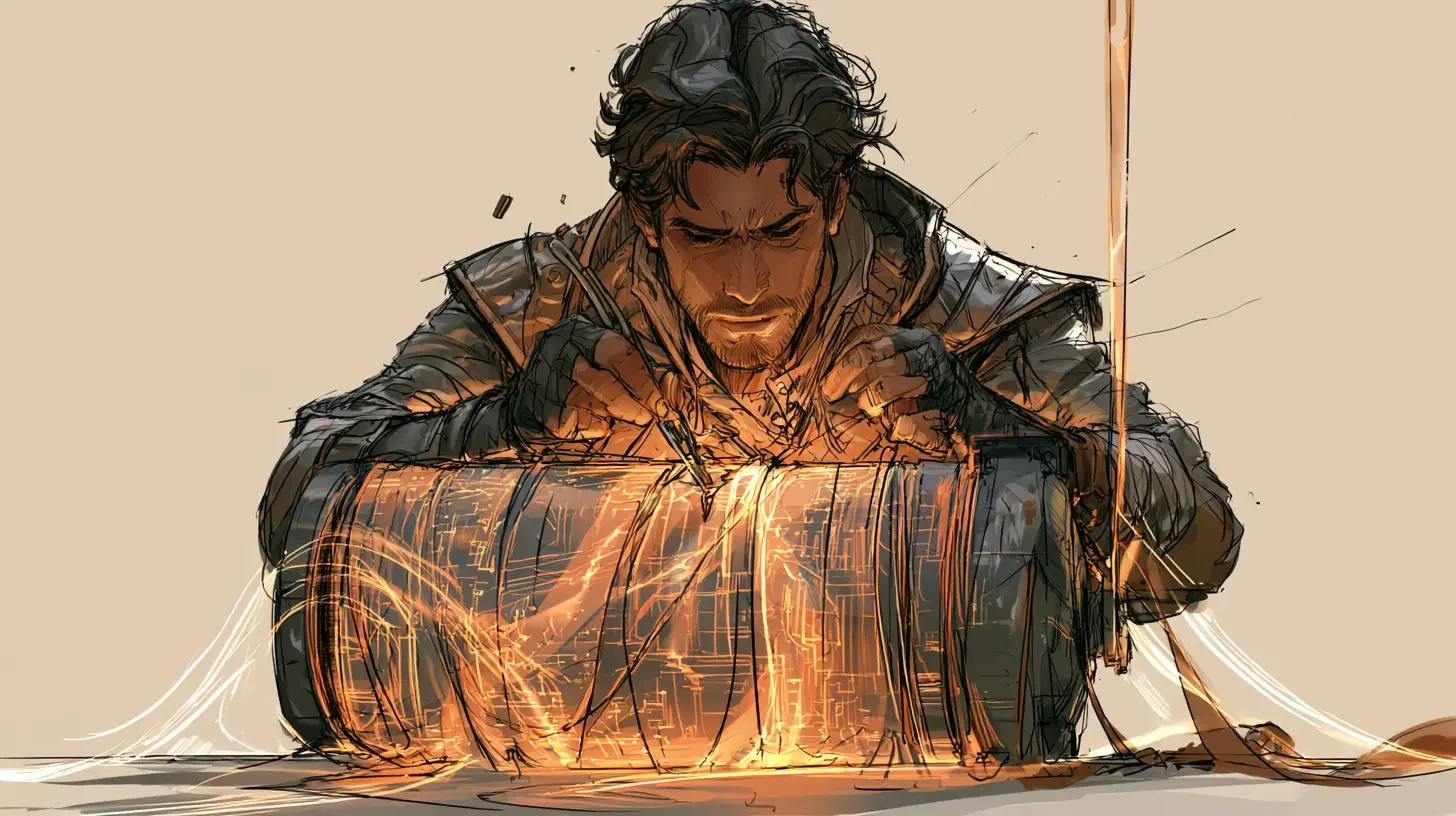
It was not the forging of machines that doomed the Engineers, but the forging of belief that machines alone could save us. In that moment, they ceased to serve the Balance—and began to serve themselves.
—Calvess Orun, The Decline of the Triune Era
Of the Three Powers, Machine is the most democratic—yet also the most imperiled. Unlike Magic and Mind, whose use is bound to those born with the necessary gift, any willing hands may learn to turn a gear, drive a nail, or shape a mechanism to purpose. This accessibility is both its greatest virtue and, as history has shown, its gravest danger.
On Necsis, technology arrives in fits and fragments, borne by the Shifts from a thousand alien worlds. A clockwork compass from a seafaring realm, a water purifier from a desert colony, an exosuit from a world of endless storms—each function here as they did in their places of origin. Yet the Shifts are fickle, and the devices arriving here rarely endure. Their fuel runs out, their makers are gone, and the knowledge of their repair dies with the moment of arrival.
It was to meet this challenge that the Engineers arose during the Triune Era. Masters of adaptation, they could coax alien mechanisms into harmony with our own materials, replicating designs or devising new ones to meet local needs. In their hands, the unpredictable bounty of the Shifts became the backbone of thriving cities and the connective tissue between distant kingdoms.
But there is a second challenge unique to Machine: the temptation of unchecked proliferation. When anyone may wield a tool, anyone may misuse it. The very openness that made technology a unifying force also made it a vector for hubris. The Engineers’ solution was rigorous apprenticeship, shared standards, and a strict ethic of stewardship—a recognition that Machine could only serve the Balance when tempered by wisdom.
Though the Ban now shackles open innovation, the essence of Machine endures. In the secret Workshops of the Mechanized Concord, in the disguised devices of guild artisans, and in the careful hands of those who still remember the Engineers’ charge, the work continues. For as long as Necsis remains tied to infinite realities, new devices will come, and the question will return: will we master them, or will they master us?
Author’s Note: Phasers on Fizzle
It will probably come as no surprise to anyone that I love Star Trek. I grew up watching the—now “Classic”—episodes as they aired in re-runs on broadcast TV. (Kids: if you don’t remember rotary phones, you might be in trouble here. Ask your parents. Or simply think of it as a kind of media purgatory.)
One episode that really captured my imagination was “Catspaw”, in which the Enterprise crew seemingly encounters a real witch and wizard—only for the truth to be something far stranger. It stuck with me, not for the plot itself, but for the idea that the Star Trek universe could brush up against something utterly alien to it… and still function.
When Necsis sprang into my mind a few years later, I realized this was a world that could, at any moment, connect with the Star Trek universe. What if Spock came through a Shift with his tricorder, phaser, and communicator—and got trapped here? The devices would work… for a while. But eventually, not even “stone knives and bear skins” would be enough to keep them running.
Thus, the Engineers were born—people trained to keep Outlandish technology alive, adapt it, and merge it with other devices. They were indispensable… but like all who wield power, they would one day pay the price.